


John Carpenter’s The Thing: From Box-Office Flop to Ultimate Cult Horror

When John Carpenter’s The Thing arrived in cinemas on 25 June 1982, it landed with the force of a snowdrift rather than an avalanche. The film, now regarded as one of the finest horror pictures ever made, was met with widespread hostility from critics and indifference from audiences. It was a commercial disaster that nearly derailed Carpenter’s career, a grim and unrelenting vision that seemed wildly out of step with the summer’s appetite for feel-good spectacle. Four decades later, the story has reversed entirely. John Carpenter’s The Thing is celebrated as a masterpiece of practical effects, a masterclass in sustained tension, and a film whose themes of paranoia and identity have only grown more resonant. This is the story of how a flop became the ultimate cult horror film, and why its frozen grip on popular culture shows no sign of thawing.
Table of Contents

The Icy Reception: Why *The Thing* Flopped in 1982
The summer of 1982 was a remarkable moment for science fiction and fantasy cinema, but not every film benefited from the genre’s resurgence. John Carpenter’s The Thing opened against Steven Spielberg’s E.T. the Extra-Terrestrial, a film that had already been in theatres for two weeks and was well on its way to becoming the highest-grossing film of all time at that point. Ridley Scott’s Blade Runner arrived on the same day, creating a three-way collision of visionary directors that left Carpenter’s film squeezed out of the conversation. Audiences, battered by a punishing economic recession, wanted warmth, wonder, and reassurance. What they got instead was a sub-zero nightmare about a shape-shifting alien that could be anyone, hiding inside anyone, with no guarantee of a happy ending.
The critical response was brutal. Reviews dismissed the film as empty shock value, a parade of grotesque imagery with no substance beneath the surface. The term “geek show” appeared more than once, a reference to carnival performers who bit the heads off live animals, and the implication was clear: this was not art, it was exploitation dressed up with a Hollywood budget. Even publications that acknowledged the technical skill on display struggled to recommend a film so relentlessly bleak. The visceral gore, which we now recognise as some of the most inventive practical effects ever committed to film, was seen at the time as excessive and gratuitous, overwhelming what little narrative the film possessed.
The box office numbers told a stark story. Produced on a budget of $15 million, with $1.5 million of that dedicated solely to Rob Bottin’s creature effects, the film managed a theatrical gross of just $19.6 million worldwide. After marketing costs and cinema splits, it was an unambiguous financial failure. For Carpenter, who had built his reputation on the lean, efficient thrills of Halloween and Escape from New York, the blow was significant. Studios that had once courted him began to keep their distance. The director later described the period as one of the most difficult in his professional life, a time when the industry seemed to decide he was no longer a safe bet.
Part of the problem lay in audience expectations. The 1951 film The Thing from Another World, produced by Howard Hawks, had established a template for the story: a plant-based alien, a clear heroic figure, and a monster that could be defeated through human ingenuity and teamwork. Carpenter’s version, drawing more faithfully from John W. Campbell Jr.’s 1938 novella Who Goes There?, offered none of these comforts. The alien was a cellular organism capable of perfectly imitating any life form it absorbed. There was no clear hero, only a group of increasingly desperate men turning on each other. The film refused to explain itself, refused to reassure, and refused to end with a victory. For audiences raised on clearer moral frameworks, it was disorienting and, for many, deeply unpleasant.
The Creature That Stole the Show (But Not the Box Office)
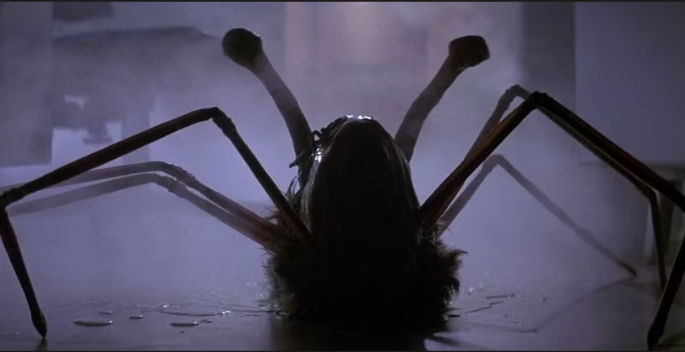
Rob Bottin was just 22 years old when Carpenter entrusted him with the creature effects for John Carpenter’s The Thing, a decision that now looks like one of the most inspired gambles in horror history. The $1.5 million effects budget was enormous for the time, and Bottin pushed every penny to its limit, working such punishing hours that he reportedly collapsed from exhaustion and was hospitalised during production. The results were unlike anything audiences had seen. The dog kennel sequence, the chest defibrillation scene, the head sprouting spider legs and scuttling away: these moments were achieved through a combination of animatronics, puppetry, latex, and sheer bloody-minded craftsmanship.
At the time, however, the effects were part of the problem. Critics who might have engaged with the film’s psychological dimensions found themselves unable to see past the gore. The transformations were so visceral, so biologically wrong, that they became the entire story in the minds of many reviewers. The film was reduced to its most shocking images, its deeper currents of paranoia and identity crisis swept aside. What is remarkable in hindsight is how well those effects have aged. Free from the digital sheen that dates so many later horror films, Bottin’s creations remain genuinely disturbing. Modern viewers, accustomed to CGI, often express disbelief that everything on screen was achieved practically. The creatures feel real because, in a very tangible sense, they were.
The Slow Thaw: How *The Thing* Became a Cult Classic
The resurrection of John Carpenter’s The Thing began quietly, in living rooms rather than cinemas. The home video market was exploding in the mid-1980s, and horror fans who had missed the film during its brief theatrical run began discovering it on VHS. Removed from the summer blockbuster context, freed from the shadow of E.T., the film found an audience capable of appreciating its claustrophobic atmosphere and Carpenter’s meticulous direction. Late-night cable broadcasts introduced it to another generation, the kind of viewers who relished the film’s refusal to compromise. Word of mouth spread slowly but persistently. This was not a film you simply watched; it was a film you told other people about.
By the late 1990s, the critical tide had turned decisively. Film scholars and genre publications began reassessing the movie, recognising what initial reviewers had missed. The nihilistic ending, in which MacReady and Childs share a bottle of whisky as the outpost burns around them, neither knowing if the other is human, was no longer seen as a failure of resolution but as a stroke of existential genius. The film’s exploration of identity, its insistence that the self is fragile and permeable, resonated with postmodern academic thought. More importantly, it resonated with audiences who had grown tired of horror films that explained too much and left nothing to the imagination.
The film’s influence on popular culture has been profound and far-reaching. The social deduction video game Among Us, which became a global phenomenon during the pandemic lockdowns of the early 2020s, is essentially The Thing rendered as a multiplayer experience. The Dead Space series of video games borrowed heavily from Bottin’s creature designs, particularly the notion of bodies twisted into impossible, agonised configurations. Episodes of The X-Files paid direct homage, and filmmakers from Quentin Tarantino to Guillermo del Toro have cited the film as a touchstone. Its DNA is now so thoroughly woven into the fabric of modern horror that younger viewers sometimes fail to recognise just how much of what they love was pioneered in that frozen outpost.
The ultimate institutional vindication arrived in 2025, when John Carpenter’s The Thing was selected for preservation in the United States National Film Registry. The Registry, established to safeguard films deemed culturally, historically, or aesthetically significant, represented the final word in a debate that had raged for over four decades. The film that had been dismissed as instant junk was now officially a national treasure, placed alongside Citizen Kane, Casablanca, and The Godfather. For the fans who had championed it through years of obscurity, the announcement felt like a personal victory.
The Paranoia Principle: Themes That Resonate Today
What makes John Carpenter’s The Thing endure, beyond the shocks and the spectacle, is its engagement with themes that feel more urgent with each passing year. The film is set during the Antarctic winter, a period of six months of darkness in which the men of Outpost 31 are cut off from all external contact. There is no rescue coming, no authority to appeal to, no society to fall back on. The isolation is absolute, and within that void, the question of who is human becomes terrifyingly practical rather than philosophical. The Thing does not simply kill its victims; it absorbs them, replicates them, wears their faces and accesses their memories. The person sitting next to you might have ceased to exist hours ago, and you would have no way of knowing.
The creature itself is fascinating because it operates without malice in any recognisable human sense. It does not hate, it does not seek revenge, it does not monologue about its plans. It simply survives, assimilating whatever biological material it encounters in order to perpetuate its existence. This amorality is, in many ways, more frightening than any traditional villain. A monster that wants to destroy the world can be reasoned with, appealed to, or at least understood. A monster that simply wants to become you offers no such foothold. It is a force of nature dressed in human skin, and the film suggests, chillingly, that the distinction between self and other is far thinner than we like to believe.
Carpenter forces the audience into the same position as the characters. We do not know who is infected, and the film deliberately withholds the information that would allow us to feel safe. Even MacReady, the closest thing the film has to a protagonist, is not exempt from suspicion. The famous blood test scene, in which MacReady tests each man’s blood with a hot wire, is as much a trial of his own humanity as it is of anyone else’s. Trust becomes a liability, cooperation a potential death sentence, and the social contract that holds civilisation together is revealed as a fragile fiction. In an era of misinformation, deepfakes, and eroding institutional trust, the film’s central anxiety feels less like science fiction and more like a documentary.

Behind the Lens: Carpenter, Russell, and the Score
John Carpenter’s approach to the material was more restrained than the film’s reputation for gore might suggest. He conceived of John Carpenter’s The Thing as a slow-burn thriller, a mystery that would gradually tighten its grip before unleashing the full horror in the third act. For much of the running time, the creature is glimpsed only in fragments: a shadow moving wrong, a sound that does not belong, a dog whose behaviour shifts imperceptibly. Carpenter understood that what the audience imagines is often more powerful than what they are shown, and he held back the full reveal until the tension had become almost unbearable. When the creature finally emerges in all its grotesque glory, the release is both horrifying and strangely cathartic.
Kurt Russell’s performance as R.J. MacReady is central to the film’s success, and it is a role that could easily have gone wrong in lesser hands. MacReady is not a conventional hero. He is cynical, pragmatic, and visibly exhausted by the stupidity he sees around him. He drinks too much, he loses his temper, and he makes decisions that get people killed. Yet Russell imbues him with a flinty integrity that makes him compelling even at his most abrasive. His character arc, from outsider who wants nothing to do with the group’s problems to the reluctant leader who takes charge when everyone else has fallen apart, is sketched with remarkable economy. The performance is a masterclass in understated masculinity, a portrait of competence under pressure that never tips into macho posturing.
One of the film’s most persistent misconceptions is that Carpenter composed the score himself, as he had done for Halloween and Escape from New York. In fact, the music was written by Ennio Morricone, the legendary Italian composer best known for his work with Sergio Leone. Morricone’s score is a minimalist marvel, built around a throbbing synth pulse that mimics a heartbeat slowly accelerating toward panic. It is music that works on the body rather than the intellect, creating a physical sense of dread that persists even in scenes where nothing overtly frightening is happening. Carpenter did contribute some additional pieces, but the core of the score is Morricone’s, and it stands as one of the most effective horror soundtracks ever recorded.
Dean Cundey’s cinematography deserves equal credit for the film’s oppressive atmosphere. Cundey, who had previously shot Halloween and would go on to photograph Jurassic Park, used wide-angle lenses and deep focus to make the interior of the outpost feel simultaneously vast and claustrophobic. The corridors stretch away into darkness, every doorway a potential threat, every shadow a possible hiding place. The lighting is deliberately harsh, often coming from a single source that leaves half the frame in blackness. This approach makes the station feel less like a refuge and more like a trap, a labyrinth from which there is no escape. The exterior shots, filmed on location in Alaska and British Columbia, convey a cold so intense it seems to seep through the screen.

*The Thing* in 2026: Where to Watch and How to Wear It
As of 2026, John Carpenter’s The Thing is widely available across multiple platforms, making it easier than ever to experience or revisit the film. In the United Kingdom, it can be streamed on major services including Amazon Prime Video and Apple TV, with rental and purchase options available through most digital storefronts. For collectors and purists, the 4K Ultra HD Blu-ray release offers a stunning restoration that showcases Cundey’s cinematography and Bottin’s effects in unprecedented detail. The film has never looked better, and the upgrade from earlier home video formats is substantial enough to justify a fresh viewing even for those who know every frame by heart.
The 2011 prequel, also titled The Thing, attempted to tell the story of the Norwegian camp whose fate is discovered by MacReady’s team in the opening scenes of the 1982 film. Directed by Matthijs van Heijningen Jr., the prequel is a curious case: a film made with evident affection for the source material that nonetheless demonstrates precisely why the original is so special. Its reliance on CGI, a decision made late in production when practical effects were largely replaced, robs the creature of the tangible, physical presence that made Bottin’s work so effective. The prequel has its defenders, and it is not without merit, but it serves primarily as a reminder that some films succeed because of their limitations as much as in spite of them.
For fans who want to carry a piece of the film with them, McLarenTeeHub www.mclarenteehub.com offers a dedicated collection of The Thing movie T-shirts and merchandise. The range includes designs that capture the stark, frozen aesthetic of Outpost 31, allowing wearers to signal their appreciation for one of horror cinema’s true landmarks. Whether you prefer a subtle reference or a bold statement piece, the collection speaks to the film’s enduring visual identity. A particularly popular item is the Outpost 31 T-shirt, which replicates the look of the doomed research station’s insignia and has become a staple for fans attending horror conventions and film festivals. The design is understated enough to wear casually but instantly recognisable to anyone who shares the obsession.
The cult of John Carpenter’s The Thing endures because the film rewards repeated viewings in ways that few horror movies manage. Each revisit reveals new details: a glance between characters that takes on different meaning once you know their fate, a line of dialogue that lands differently when you are looking for clues, a moment of body language that might indicate who is no longer human. The film does not solve itself on a second or third watch; it deepens, becoming richer and more unsettling as the viewer becomes more attentive. That quality, combined with effects that remain astonishing four decades on, ensures that new generations will continue to discover it.
The Ultimate Test: The Blood Test Scene
If a single sequence can be said to encapsulate everything that makes John Carpenter’s The Thing a masterpiece, it is the blood test scene. The setup is deceptively simple: MacReady, having realised that every part of the creature is an independent organism, devises a test in which a sample of each man’s blood is exposed to a hot wire. If the blood reacts, the man is the Thing. What follows is roughly ten minutes of almost unbearable tension, as each man is strapped to a chair and tested in turn. The scene takes a logical, almost scientific premise and transforms it into a life-or-death gamble where the stakes could not be higher.
The practical execution of the scene is a triumph of timing and puppetry. When the blood finally leaps from the petri dish, recoiling from the heat with a shriek that seems to come from somewhere beyond the physical world, the effect is achieved without a single frame of computer-generated imagery. It is a moment of pure cinema, the kind of alchemy that occurs when craft, performance, and direction align perfectly. The scene has been parodied, referenced, and homaged so frequently that it has become a cultural shorthand for proving someone’s identity under pressure. It is, quite simply, one of the greatest sequences in horror history.

Conclusion: The Flop That Won
John Carpenter’s The Thing is the ultimate vindication story, a film that was rejected by its own era only to be embraced by every era that followed. It went from career-damaging flop to National Film Registry inductee, from critical punching bag to universally acknowledged masterpiece. The journey took decades, but the verdict is now beyond dispute: this is essential cinema, a work of craft and vision that transcends its genre.
Whether you are returning to the frozen hell of Outpost 31 or steeling yourself for a first viewing, the film remains as potent as ever. Its questions about identity, trust, and survival have not aged a day. For those who wish to carry that legacy beyond the screen, the official The Thing collection at McLarenTeeHub offers a way to wear a piece of horror history. The flop that won is still winning, and it shows no sign of stopping.


Comments